
Go purple for gynae cancer this Spring
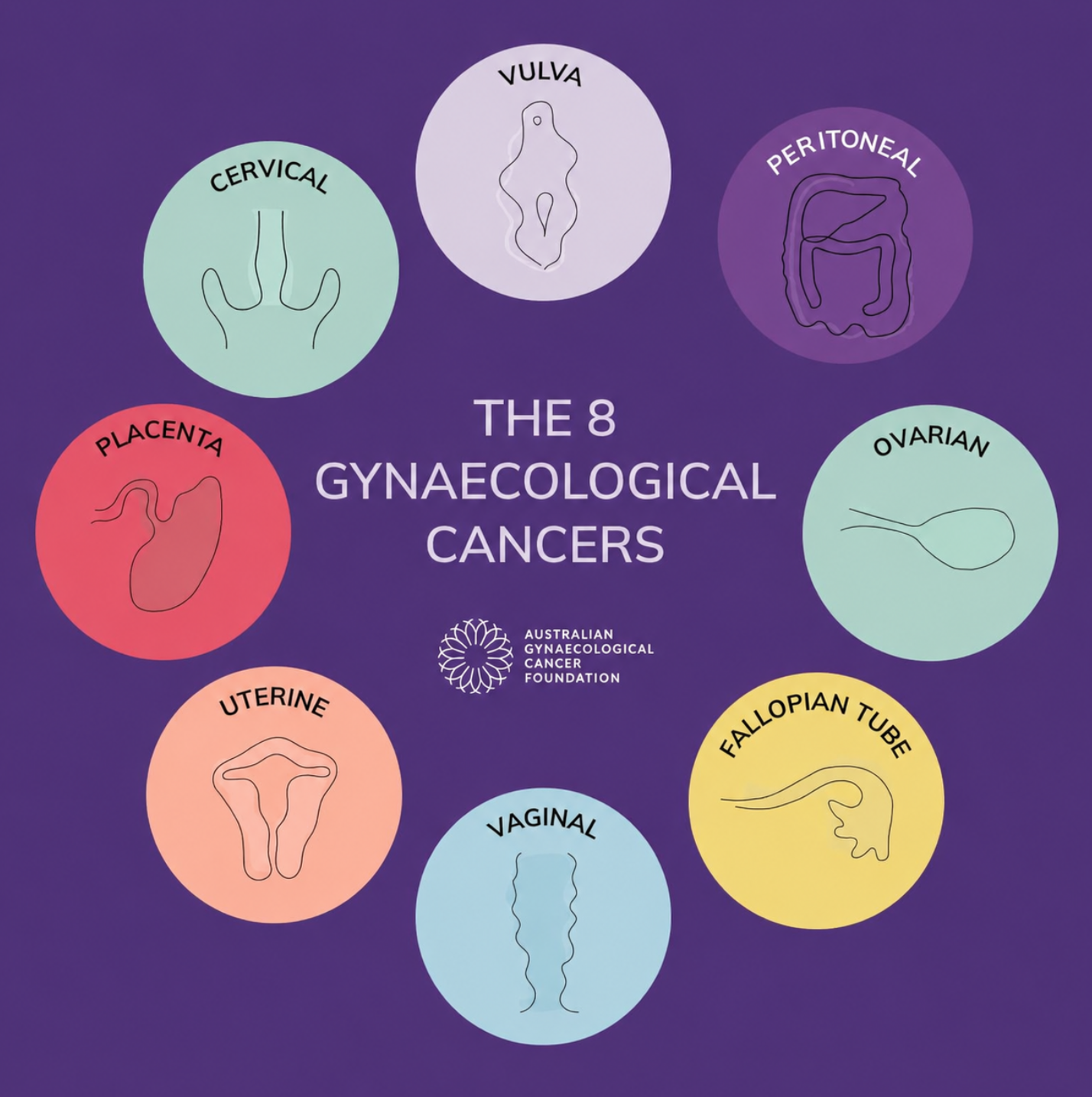
We wanted to share with you the newsletter findings from the Australian Gynaecological Cancer Foundation as staunch supporters of women’s health especially this important field, often overlooked.
September is Gynaecological Cancer Awareness Month, so we would like to give you an overview of all the gynaecological cancers. The AGCF is the only Foundation in Australia funding laboratory research into all such malignancies.
The gynaecological cancers are those that involve the female reproductive organs, viz the vulva, vagina, cervix (neck of the womb), uterus (womb), fallopian tubes, and ovaries. Malignancies of the placenta (afterbirth) and peritoneum (lining of the abdomen) are also treated by gynaecological oncologists.
The commonest of the gynaecological cancers is endometrial cancer, which accounts for over 90% of uterine cancers. It is a cancer of the lining of the uterus (the endometrium), which is shed with menstruation each month in reproductive aged women. Cancers of the muscle of the uterus (which are much less common but have a higher mortality) are called leiomyosarcoma. The estimated number of new cases of endometrial cancer diagnosed in Australia in 2022 was 3,343, representing 4.6% of all new female cancers. There were 667 deaths from the disease, representing 3.0% of female deaths from cancer in that year. The overall 5-year survival for endometrial cancer was 83%. This good prognosis is due to the fact that the disease usually presents early with abnormal vaginal bleeding (usually post-menopausal bleeding), so can be readily diagnosed by uterine curettage.
The second most common gynaecological cancer is ovarian cancer. The estimated number of new cases of ovarian cancer (including serous carcinomas of the fallopian tube) diagnosed in Australia in 2023 was 1,786, which represents 2.4% of all new female cancers. The estimated number of deaths from ovarian cancer in 2023 was 1,050, which represents 4.6% of all female deaths from cancer. The chance of surviving at least 5 years was 49%. The high mortality for ovarian cancer is due to the fact that there are usually no symptoms of early disease (the silent killer), and no screening test is available. Hence, most women have advanced disease at the time of diagnosis.
Many cases of ovarian cancer are now known to arise in the fallopian tubes, particularly in patients who have the hereditary BRCA 1 and BRCA 2 genes. Some of these cancers that arise in the fallopian tubes spread to the peritoneum (the lining of the abdominal cavity) without significant ovarian enlargement. Therefore, serous cancers of the ovary, fallopian tubes and peritoneum are now all considered to be part of the same disease. All require surgery to remove the cancer, and unless the disease is found to be confined to the tube or ovary, they will all need chemotherapy. Rarely, the fallopian tubes and peritoneum may be sites of primary cancers unrelated to ovarian cancer.
The third most common cancer is cancer of the cervix. In 2022, it was estimated that there were 942 new cases of cervical cancer in Australia, representing 1.3% of all new female cancers. The estimated number of deaths was 222, which represented 1.0% of all female deaths from cancer. The chance of surviving at least 5 years was 74%. The incidence of cervical cancer has halved since the introduction of the National Cervical Screening Program in 1992.
In the Indigenous population, the incidence of cervical cancer is twice as high as in the Caucasian population, and the mortality is four times higher. This is due to lack of access to, or uptake of, cervical cancer screening. The disease is caused by infection with the human papilloma virus (HPV), and primary screening is now performed by HPV testing. Pleasingly, the availability of self-testing for HPV has seen an increased uptake of screening among Indigenous and non-English speaking women in recent years. The introduction of HPV vaccination for girls aged 12–13 years in 2007, and for boys in 2013, will see the incidence of cancer of the cervix fall markedly in the years ahead.
Vulvar and vaginal cancers are uncommon, there being an estimated 420 women diagnosed with vulvar cancer in 2022, and 123 diagnosed with vaginal cancer. The 5-year survival for vulvar cancer was 74%, while for vaginal cancer it was 49%. About 35% of vulvar cancers and 70% of vaginal cancers are caused by HPV, so the HPV vaccination program for schoolgirls and boys will significantly decrease the incidence of these cancers in the future.
The final group of gynaecological cancers arise in the placenta or afterbirth. They are called invasive moles or choriocarcinomas. These cancers are rare, but are very sensitive to chemotherapy, even in the presence of disease which has spread to the lungs or other distant sites.
Neville F Hacker AM MD
Founder and Director
Australian Gynaecological Cancer Foundation
Australia on track to eliminate cervical cancer
Outstanding gynae cancer reduction results: Australia is on track to become the first country in the world to eliminate cervical cancers with HPV vaccine by 2035. AIHW national data from July 2026 reveals a shifting cancer landscape.
Cervical cancer is vanishing from a generation of Australian women, with a new AIHW national data report revealing it is happening, one age bracket at a time.
The AIHW reported in July 2026 that among women aged 25 to 29, cervical cancer has almost disappeared. Incidence in that group has fallen from 9.3 cases per 100,000 in 2013 to a projected 0.5 in 2025 – a decline of roughly 95 per cent.
Professor Neville Hacker AM MD, Founder and Director AGCF, welcomed the news and provided the following comments:
Cancer of the cervix has been known to be caused by the Human Papilloma Virus (HPV) since the 1980s. There are about 70 different types of these viruses, but 15 are considered to be “high risk” and these are the ones that cause the cancer. In 2006, Drs Ian Frazer and Jian Zhou, working at the Diamantina Research Laboratory at Princess Alexandra Hospital in Brisbane, invented a vaccine against some of these high-risk HPV viruses, and this vaccine has allowed primary prevention of the disease. Secondary prevention via screening, initially with the Pap smear, and more recently by testing for the HPV virus, is also effective if undertaken regularly. Developed countries like Australia have access to well organised screening programs and to the HPV vaccine, so the incidence of cervical cancer is relatively low. The disease is on track to be 90% eliminated across all age brackets within decades, through use of the vaccine and screening programs.
However, as reported by the AIHW 2025, the MJA 2026, and reiterated by Professor Hacker, to ensure timely and equitable elimination of cervical cancer in Australia, disparities in coverage among underserved populations must continue to be addressed — including for those living in remote regions, First Nations people, people with disabilities, and many of those from other countries — and the recent declines in vaccination and screening uptake must be reversed.
From the AIHW National Cervical Screening Program monitoring report, November 2025
Cervical cancer elimination is defined as having an incidence rate of fewer than 4 new cases per 100,000 women per year.
Current statistics
New cases: In 2021, Australia recorded 6.2 new cases per 100,000 women, with 886 women diagnosed.
Deaths: In 2023, 210 women died from cervical cancer, about 2 to 3 deaths per 100,000 women.
Screening trends: Most cervical cancers occur in women who have never been screened or who have lapsed past their recommended check schedule.
Key drivers of progress
HPV vaccination: Australia started a national human papillomavirus (HPV) vaccination program in 2007, which successfully lowered viral infections.
Screening program: The National Cervical Screening Program uses 5-yearly HPV tests for people aged 25–74.
Self-collection: A choice for self-collected vaginal samples was introduced in July 2022 to make screening more comfortable and accessible.
Remaining challenges
Equity gaps: Access to HPV vaccine and screening remains lower in remote regions, for First Nations people, and for people with disabilities.
Treatment timeliness: Some patients with high-grade abnormalities experience delays in receiving follow-up treatment within recommended timeframes.
See more on national progress and barriers in the Medical Journal of Australia: Med J Aust 2026; doi:10.5694/mja2.70164
Ovarian cancer survivor shares her story 44 years later
A remarkable full-circle story of survival, gratitude and hope unfolded last month when American ovarian cancer survivor Brenda “Farah” Coleman travelled to Australia to reunite with the surgeon she credits with saving her life more than four decades ago. At just 22 years of age, Farah was diagnosed with advanced ovarian cancer after presenting to a California hospital with severe pelvic pain. Farah had two operations then was devastatingly informed that her cancer was incurable and that palliative care was her only option. Determined to seek answers, Farah challenged that prognosis. Her treating gynaecologist subsequently arranged a referral to Dr Neville Hacker at the University of California, Los Angeles (UCLA), where she underwent extensive surgery and chemotherapy. The treatment proved successful, and Farah went on to build a fulfilling life and career. She has had no contact with Dr Hacker since her treatment was completed.
Now, 44 years later, Farah travelled from the United States to Australia to personally thank Professor Neville Hacker AM MD, founder of the Australian Gynaecological Cancer Foundation (AGCF), for the role he played in her survival. Farah recently chronicled her extraordinary journey in her autobiography, Twelve and Se7vn, named in honour of her family as the youngest of 12 children from her mother and seven children from her father. During her visit to Sydney from 23 to 26 June, Farah met with AGCF Chair Diane Langmack OAM and CEO Georgina Laverty-Bill, and toured the historic Royal Hospital for Women, where Professor Hacker served as Director of the Gynaecological Cancer Centre for more than three decades. Farah presented a commemorative plaque to the current Director, Dr King Man Wan. The reunion highlights the profound and lasting impact of specialist gynaecological cancer care and breakthrough research, and serves as a powerful reminder of why continued investment in women’s cancer research remains critical.
Professor Hacker, who later established AGCF to advance life-saving laboratory research and improve outcomes for women diagnosed with gynaecological cancers, said stories like Farah’s demonstrate the life-changing potential of expert treatment and ongoing medical innovation. Farah’s visit celebrates not only one woman’s survival, but also the importance of hope, advocacy and research in changing the future for women diagnosed with gynaecological cancer.